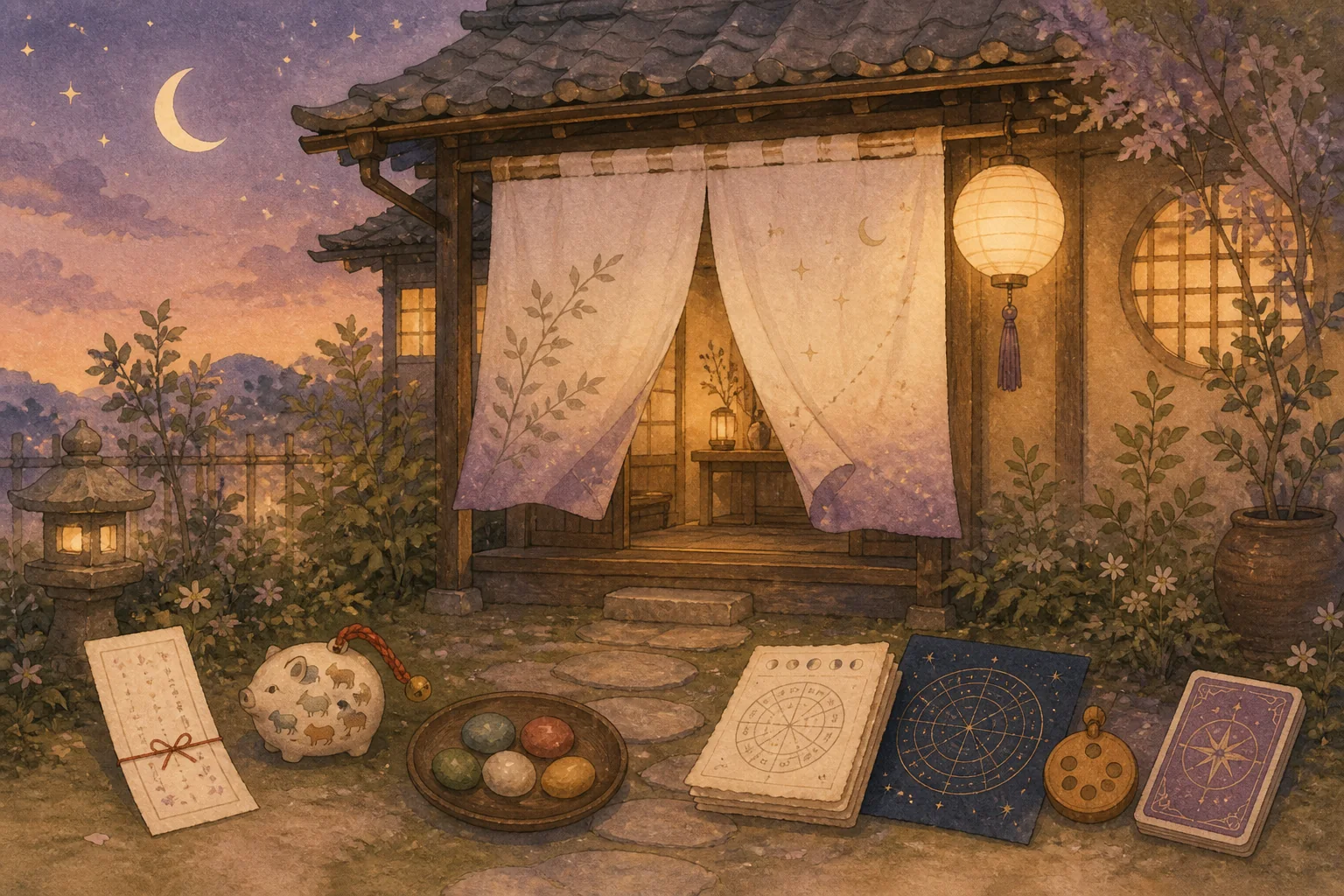
7 Types of Japanese Fortune Telling Which door fits your question?
Fortune-telling methods are good at different kinds of questions. A one-line prompt for today is not the same as a layered birth reading. Step through the noren curtain that fits what you need now.
No registration. Treat every result as entertainment and a prompt for reflection, not a guarantee.
Fortune Noren Guide
Choose the question that feels closest. We match the time horizon and purpose of your question, not a claim of which method is “most accurate.”
Seven methods at a glance
Method
Main input
Useful question
Time horizon
Omikuji
A randomly drawn message
How can I meet what is in front of me?
Today / now
Japanese zodiac
Year, month, day, or hour branch
What roles and rhythms do I carry?
Traits / cycles
Four Pillars
Birth date and time
How do elements and tendencies interact?
Long life patterns
Nine Star Ki
Birth date and seasonal boundaries
How do outer and inner energies differ?
Year / month
Calendar customs
Solar terms, cycles, annotations
What can mark a useful beginning?
Day / season
Zodiac signs
The Sun's zodiac position
How do I express and direct energy?
Traits / daily
Numerology
Digits in a birth date
What theme tends to repeat?
Life theme
Seven doors
Receive a phrase
Omikuji
A shrine or temple fortune slip. The practical lines matter more than collecting the “best” luck rank.
Some customs developed in Japan, while others came through Chinese calendar traditions or arrived from Western astrology and numerology before becoming part of Japanese magazines, websites, and everyday conversation. It is more accurate to see Japanese fortune telling as a meeting place of methods than as one ancient school.
The 24 solar terms, for example, are seasonal markers defined by the Sun's longitude and are relevant to calendar boundaries in Four Pillars and Nine Star Ki. Omikuji are also more than a ranking: Japan's Association of Shinto Shrines explains the importance of using the written content as guidance for life.
Hoshiyomi Chaya's twist We organize methods by the time span of the question. Omikuji can prompt today's action; Four Pillars can frame longer tendencies; Nine Star Ki can support seasonal adjustment. Each reading ends with something small enough to try in a few minutes.